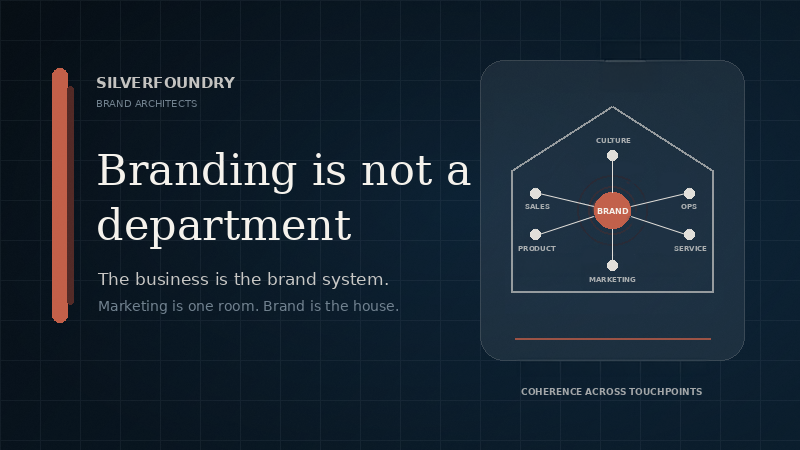
Ask ten founders where brand sits in their business and nine will point to the same place: under marketing, somewhere near the logo and the social calendar. It feels right. It is also the most expensive assumption a growing company can make.
Brand is not a function you run alongside sales and operations. It is the thing all of those functions add up to. When you treat it as a department, you cap it at that department’s reach, and the rest of the business spends every day either reinforcing the brand or quietly tearing it down without knowing which.
This article makes the case for moving brand up the org chart, out of marketing and above it, and shows what changes when you do.
The assumption that costs you money
Picture the standard setup. Brand lives inside marketing. It reports to the CMO. It shares a budget line with campaigns, content and design. Tidy, contained, easy to manage.
It is also backwards, and the cost shows up in places nobody traces back to brand. A prospect who felt premium on your website meets a clumsy onboarding email and downgrades you in their head. A deal stalls because your proposal looked sharper than the sales call that followed it. A loyal customer hits one rude support reply and starts taking competitor calls. None of those moments happened in marketing. All of them shaped your brand.
A business can double in real value and still look identical to the market. That gap between what you have become and what the market still perceives is where pricing power leaks out. You discount to win work you should command a premium for. You compete on price against companies you have outgrown. The brand never caught up because only one department was ever allowed to build it.
What a brand actually is
Here is the definition worth internalising: your brand is the sum of every experience a customer has with you. Not the logo. Not the tagline. Not the colour palette. Those are signals of the brand. They are not the brand itself.
The brand is the pitch and the follow-up. The promise and the delivery. The brochure and the support ticket at five on a Friday. Customers do not separate these moments into departments the way your org chart does. They experience one company, form one impression, and that impression is your brand whether you authored it on purpose or left it to chance.
Once you accept that, the conclusion is unavoidable. If experience is the brand, then everyone who touches a customer is building it. Sales. Service. Product. Finance. The person who answers reception. Brand stopped being marketing’s job the moment your first customer interacted with someone outside the marketing team.
Marketing is one room in the house. The brand is the house.
The moments you never counted as branding
Most brand erosion happens in places no marketer ever audits. Run your own business through these four and notice how many sit far outside the marketing team:
- 01How fast you answer the phone, and who picks up
- 02What your invoice feels like to receive and how clearly it reads
- 03The tone of a support reply when something has gone wrong
- 04Whether the product delivers what the pitch promised
Every one of those is a vote your customer casts on what your brand really stands for. Marketing can make a beautiful promise. If the rest of the business never agreed to keep it, the gap between the two becomes the lasting impression. That gap is where trust drains and customers quietly decide you are replaceable.
What changes when brand moves up
Lift brand above marketing and three things shift.
Decisions get a shared filter. When brand is the organising idea rather than a campaign style, every team has a way to answer “does this fit?” The way an account manager handles a complaint and the way the product team prioritises a fix both run through the same standard. Consistency stops being something you police and starts being something the business produces on its own.
The signal gets stronger. Get the brand right and every department starts telling the market the same story. Get it wrong and the market hears static, a sharp ad followed by a sloppy handover followed by a confusing renewal. Coherence across touchpoints is the difference between a brand the market trusts and a company it merely tolerates.
You stop competing on price. When the whole experience reinforces what you are worth, you give the market fewer reasons to treat you as a commodity. Pricing power is downstream of perceived coherence. Scattered brands discount. Coherent brands command.
This is the principle underneath everything we build at SilverFoundry. A brand is not decorated into existence by a marketing team. It is architected, from the inside out, so that meaning, positioning and experience line up before a single design choice is made. Strong brands are not the prettiest ones in the category. They are the most coherent.
Where to start
You do not need to restructure the company this quarter. You need to stop treating brand as one team’s property and start treating it as the standard the whole business is held to.
Begin with one honest audit. Walk your own customer journey end to end, from first ad to first invoice to first complaint, and mark every point where the experience contradicts the promise. Each contradiction is a place your brand is leaking. Fix those, and you strengthen the brand at every touchpoint at once, which is something no campaign can ever do on its own.